

Dr A. P. J. Abdul Kalam’s Legacy of Eternal Vision
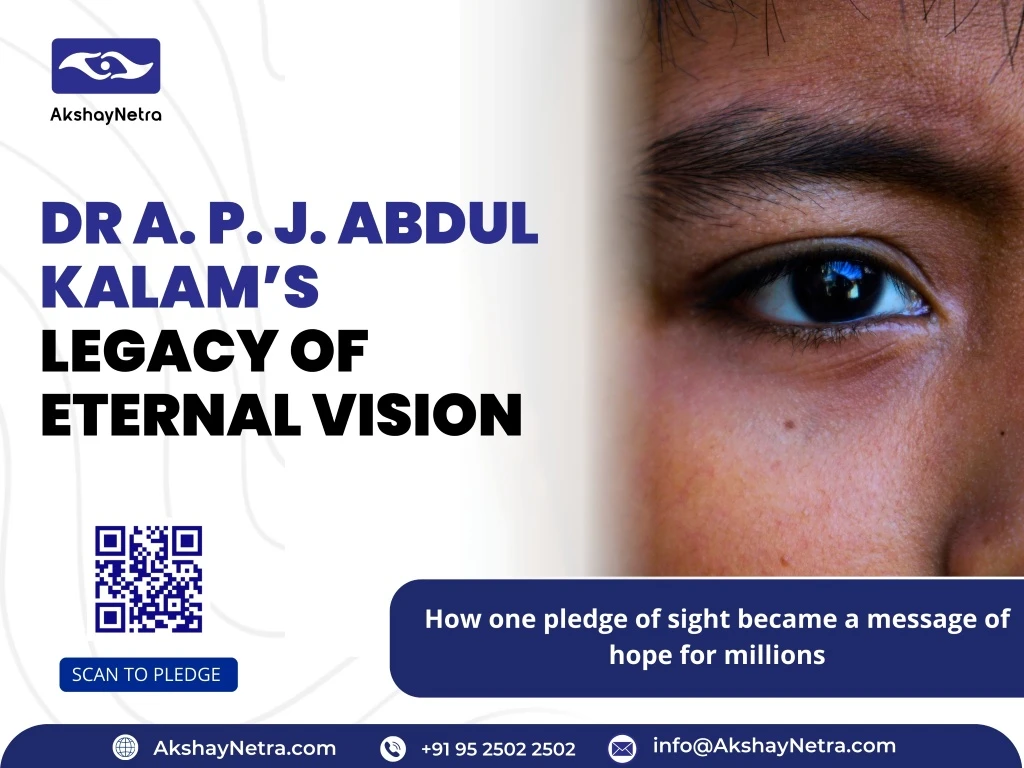
How one pledge of sight became a message of hope for millions
The Quiet Privilege of Seeing
Sight is one of the most profound yet overlooked abilities. It allows us to recognise a loved one’s face, read a sentence without effort, and observe the subtle changes of the sky at dusk. These experiences are so deeply woven into everyday life that we seldom pause to acknowledge them. Only when vision is lost does its true value become clear.
Akshay Netra invites us to reflect on this quiet privilege and consider how it can be shared with those who live in darkness.
Inspiration from Dr A. P. J. Abdul Kalam
When A. P. J. Abdul Kalam pledged his eyes, he turned a personal decision into a powerful national example. His choice demonstrated that legacy is not only built through achievements but also through acts of compassion that continue beyond one’s lifetime.
Medical science shows that a single donor can restore sight to two individuals through corneal transplantation. Behind this clinical fact lie deeply human moments: the first clear image after years of blur, the first line of text read independently, and the first time a face comes into focus again.
From Awareness to Understanding
Eye donation is often delayed not by unwillingness but by uncertainty. Families are frequently required to make decisions during moments of grief without prior discussion or knowledge. This leads to hesitation, even when the donor had wished to give.
AkshayNetra addresses this challenge by encouraging informed conversations within families. When awareness is shared in advance, consent becomes a collective understanding rather than a hurried choice. Knowledge replaces fear, and clarity replaces doubt.
The Science of Restoring Sight
Corneal transplantation is a safe and highly successful procedure. Only the cornea, the transparent front layer of the eye, is used. The retrieval process is respectful and does not affect appearance or funeral practices. With proper coordination between hospitals and eye banks, donated corneas can restore vision efficiently and effectively.
The medical aspect is straightforward; the real transformation lies in the human connection created between donor and recipient.
Light That Continues Beyond Life
Eye donation represents continuity. It allows vision to extend beyond the lifespan of the donor, offering independence and opportunity to someone else. For recipients, restored sight means returning to education, employment, and social interaction. For donor families, it provides a sense of purpose and comfort in knowing that their loved one’s light continues.
Akshay Netra approaches this process with sensitivity, ensuring respect for both donor and recipient while promoting a culture of preparedness and compassion.
A Shared Responsibility
Creating lasting change requires open dialogue, accurate information, and timely action. When individuals pledge their eyes and inform their families, they remove uncertainty and make the path towards donation clear. This preparation transforms a moment of loss into an opportunity to restore sight.
Conclusion
The ability to see is a gift that carries immense meaning. By choosing to pledge our eyes, we allow that gift to continue beyond our lifetime. Inspired by the example of A. P. J. Abdul Kalam and supported by initiatives such as AkshayNetra, we can ensure that light is never lost but simply passed on. In sharing vision, we create a legacy defined not by what we leave behind, but by the lives we illuminate.
MONTHLY MAGAZINE
Social media icons